

Loading... Please wait...If you have a pet bird, chances are that you’ll experience bird bites from time to time. Birds occasionally bite out of fear, to protect their territory, due to raging hormones and feeling misunderstood. These bird bites tend to be more of a “shot gun” like reaction and are not a sign of a “mean bird.” Birds that repeatedly bite, though, may have actually been unintentionally trained to bite. Just like we can unintentionally train our bird to scream, we can unwittingly teach them to bite. The good news is that we can re-train our bird (and ourselves) that biting is unacceptable.
Preventing bird bites is best when it comes to handling our parrots. Learn to read your parrots body language because that is the only way your parrot can communicate with you. When you can tell what your bird is trying to tell you and then use effective methods to deal with it you are preventing a situation in which your bird may bite. It’s very similar to some of the techniques we use when dealing with young children whose speech is difficult to understand. We anticipate issues and distract or redirect feelings or thoughts.
READ YOUR BIRDS BODY LANGUAGE: When you know why your bird bites and learn to read its body language, you will feel more comfortable handling your parrot and you’ll be taking some important steps to avoid bird bites. Agitated or scared birds can’t tell us how they feel, but they always show us how they feel. You can learn to quickly gauge your bird’s mood by recognizing common bird body language. Usually, there are a series of cues, including:
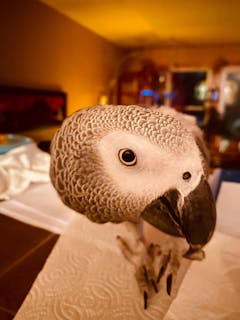
1. Eye Pinning: An agitated bird may pin its eyes. This is when a bird quickly expands and contracts the pupils of its eyes.
2. Feather Ruffling:
3. Lunging
4. Hissing 5
. Head-bobbing
DISTRACT: Create a habit of quickly learning how to distract an agitated or scared bird. Take a few moments to generate a list of when your bird usually bites. Once you know what type of situations provoke a bird bite, you can anticipate a potential behavior problem and proactively plan on how to avoid it. If your bird bites when you are holding it, get into the habit of jiggling the hand that is holding it when you see a bite coming, so as to shift the bird’s attention from biting to balancing. You only need to jiggle enough to temporarily throw the bird off balance. Another technique to safely distract your bird is blowing in its face. I f your bird bites during transitions, like when you put it back in its, create a distraction of putting a favored treat in its bowl or giving it a treat when it steps onto its cage perch.
STICK TRAINING: Stick training is another great way for you or even a pet sitter to avoid bird bites. Teach your bird to step up onto a stick, like The Percher. A good source for teaching stick training is Good Bird Inc. Make sure that you teach the bird to associate getting up on the stick with pleasure. For instance, when your bird gets on the stick, talk fondly to it or give it a treat.
FESS UP: It is not at all that uncommon to unintentionally teach a bird to bite. After all, our human reaction feeds into a parrot’s way of communicating. When we screech or scream in reaction to a bird bite, it sounds a lot like the way parrots communicate. On top of that the simple reaction of pulling away is exactly what the parrot wants! So, birds receive an instant reward with the normal human reaction to a bite. If you have unintentionally trained your bird to bite, just fess up to the error of your ways and retrain. While it may take a while for your bird to understand that biting doesn’t get the reaction it had hoped for, with dedication you can retrain a biting bird surprisingly fast.
How? Well, the first thing to do is study parrot body language and specifically, what situations incite a bird bite from your parrot. Once you understand these two things, you’ll be amazed at how well your parrot has been communicating its wants and needs with you! A parrot that has been trained to bite, though, will still bite. So you need to plan your reaction when the inevitable happens. Prevention is the bird training method of choice. Learn the O-P-A-L-S method for managing a biting bird.
O – Observe and study situations that your bird tends to bite most. Is your bird fearful, hormonal, being territorial, trying to tell you it doesn’t want to held or has it just been trained to bite? Once you know why your bird is biting, you can figure out a plan to stop bird bites.
P – Prevent bites as much as possible with sidetracking techniques like “step up” on a stick like the Percher, or putting a treat in the food cup when placing bird in its cage; sidetrack fear and anxiety as much as possible. Remember that every time your bird bites you, it a bird training opportunity to refine biting techniques!
A –Anticipate & plan all handling situations prior to engaging your bird. Figure out how your bird has acted in past situations of similar handling. For instance, if your parrot is going through a stage where it doesn’t want to go back to its cage, let it watch you put treats in its bird cup prior to putting it in the cage for a short term solution. A long term solution is to work on your bird training of teaching your bird to get in and out of its cage. Offer immediate and meaningful rewards if your bird chooses to NOT try to bite.
L – Learn Bird Body Language from the experts of GOOD BIRD. Apply research based bird training advice to your bird – what language does your bird use to tell you to “back off” S – Sensory rewards to make handling rewarding and fun… QUICKLY reward your bird on every sensory level you can think of! (Sight, hearing, touch, taste, smell) sweet talk, smell & taste its favorite treats, give it favorite scritches. So, for instance, make or buy a Bird Training & Treat Dispenser like the one pictured. When your bird sees this bird training device, it is rewarded at 4 sensory levels. Your bird wants to behave as expected when it sees the device that allows almost immediate rewards for expected behaviors; bird hears the click, tastes the treat, and potentially smells the treat.
S – Sensory rewards to make handling rewarding and fun… QUICKLY reward your bird on every sensory level you can think of! (Sight, hearing, touch, taste, smell) sweet talk, smell & taste its favorite treats, give it favorite scritches. So, for instance, make or buy a Bird Training & Treat Dispenser like the one pictured. When your bird sees this bird training device, it is rewarded at 4 sensory levels. Your bird wants to behave as expected when it sees the device that allows almost immediate rewards for expected behaviors; bird hears the click, tastes the treat, and potentially smells the treat.